By InsightTech AI Team
15 Sep 2026
6 min read
Providing developers the best model for the task at hand has always been our core goal. Earlier this year, we made that easier by launching Auto model selection, which reviews your task and matches it to the best-suited model for that task. Today, we are introducing Project HydraFusion, a research preview that delivers frontier intelligence through runtime orchestration. This system creates a full execution plan, choosing from models across multiple providers to draft, critique and revise, or cascade to more powerful models to complete your task.
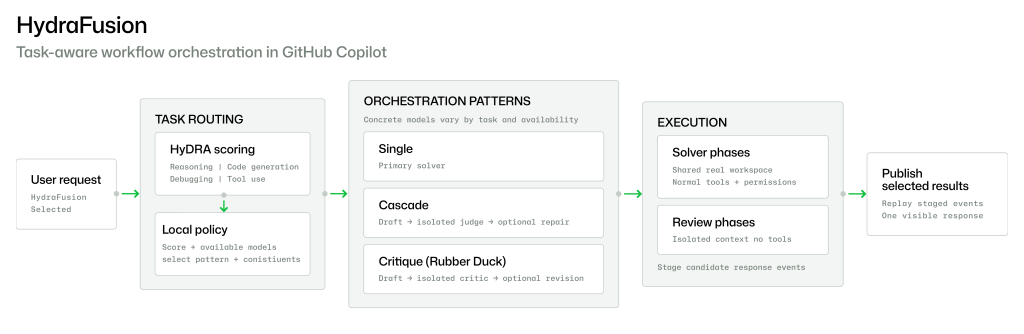
HydraFusion fills a key role in our overall strategy to deliver automated semantic routing between local, cloud, and compound models. For developers, that complexity stays behind the scenes: you select HydraFusion like any other model, and it chooses a workflow that balances performance, cost, and latency for each task. HydraFusion treats workflow selection as an optimization problem. It uses capability signals for reasoning, code generation, debugging, and tool use to select the most efficient execution pattern to meet the quality bar.
For each request, HydraFusion currently chooses one of three execution patterns: Single, Cascade, and Critique. The Single pattern allows one selected model to solve the task directly. The Cascade pattern involves an efficient model drafting a solution and a quality gate deciding whether to accept it or escalate to a stronger model. The Critique pattern has one model draft a result, an independent read-only critic from a different model family reviews it, and the drafting model revises once.
Each pattern addresses a different quality-to-cost trade-off. Single preserves speed and efficiency when one model can solve the task directly. Cascade gives an efficient model the first attempt while retaining a path to stronger inference when the candidate does not clear the acceptance gate. Critique adds an independent perspective for tasks where review is more useful than another unaided attempt. In offline evaluations across three agentic coding benchmarks, HydraFusion consistently demonstrated frontier-level quality with substantial estimated cost savings. On TerminalBench 2.1, it improved verified task quality by 4.9 percentage points at 67% lower estimated cost compared with Claude Opus 5.
Developers already coordinate models manually: choosing one for a task, asking another to review the work, or escalating a difficult problem to a more capable model. HydraFusion brings that familiar process into the runtime. You choose HydraFusion once and stay focused on your task while it manages the models and workflow behind the scenes. The key is selectivity; some coding tasks can be solved directly, while others benefit from review, revision, or escalation. HydraFusion evaluates each request and chooses the least complex workflow expected to meet its needs.
As the model frontier advances, so does HydraFusion. When new models become available in GitHub Copilot, we can evaluate and incorporate them into its model pool. This brings their strengths to the tasks best suited to them. Turning adaptive multi-model orchestration into one dependable coding experience requires careful control of execution, review, cost, and repository state. HydraFusion is built around the principle of complete accounting, which aggregates cost and usage across every workflow leg, including drafting, critique, revision, escalation, retry, and fallback.
At InsightTech, we believe that enterprise AI integrations must be optimized not only for performance but also for cost-efficiency and security. The 'Bounded Execution' principle of HydraFusion gives each leg explicit timeout and cancellation behavior, ensuring that costs and resource usage remain within defined limits. This approach minimizes risks such as unexpected API costs or infinite loops while providing predictability for enterprise budget management.
Furthermore, the 'Isolated Review' principle ensures that review steps are run in isolated, tool-less contexts, reducing data leakage risks. This guarantees strict adherence to security protocols even when sensitive enterprise data is sent to third-party model providers. The InsightTech engineering team emphasizes that such orchestration layers must be supported with observability and tracing mechanisms when integrated into existing CI/CD pipelines.
Project HydraFusion clearly outlines the future direction of AI-assisted software development tools: dynamic model orchestration optimized for task context rather than a single 'best' model. This approach has the potential to significantly reduce Total Cost of Ownership (TCO) for businesses while increasing developer productivity. Systems that can offer frontier quality at standard costs accelerate the return on investment for AI initiatives.
InsightTech is updating its platforms and consulting services to offer these next-generation orchestration capabilities to its clients. In the near term, we are preparing roadmaps on how to enable HydraFusion-like architectures in enterprise data centers and hybrid cloud environments. Developers and technology leaders can maintain quality standards while reaching new peaks in operational efficiency by adopting these adaptive approaches.
Experience a spring of truth flowing from cutting-edge innovation at InsightTech, shaping the digital future with excellence and integrity.
InsightTech Editorial Team
GitHub Copilot'ın yeni araştırma önizlemesi Project HydraFusion, çoklu model orkestrasyonu sayesinde frontier seviyesindeki kod kalitesini …
Sep 15, 2026
Enter your email to receive our latest newsletter.
Don't worry, we don't spam
At InsightTech, we focus on delivering high-impact technology solutions that empower businesses.
Get a Quote